If you’ve spent more than five minutes in Mexico, you’ve probably heard it. It’s shouted at soccer matches, whispered in art galleries, and used to describe everything from a spicy salsa to a brilliant engineer. That word is Chingón.
However, if you look it up in a standard Spanish dictionary, you might find a confusing definition or a warning that it’s “vulgar.” While it stems from a “strong” root (the verb chingar), in modern Mexico, Chingón has evolved into a badge of honor, a superlative of excellence, and a cornerstone of our national identity.
When you hear “En México somos bien chingones,” it’s not an insult. We are simply saying that in Mexico, we are very good at getting things done. And don’t feel bad—surely people in your country are chingones too!
In this deep-dive guide, we are going to explore the more than 100 nuances of this word so you can stop guessing and start using it like a true local. ¡Vamos a darle! (Let’s get to it!)
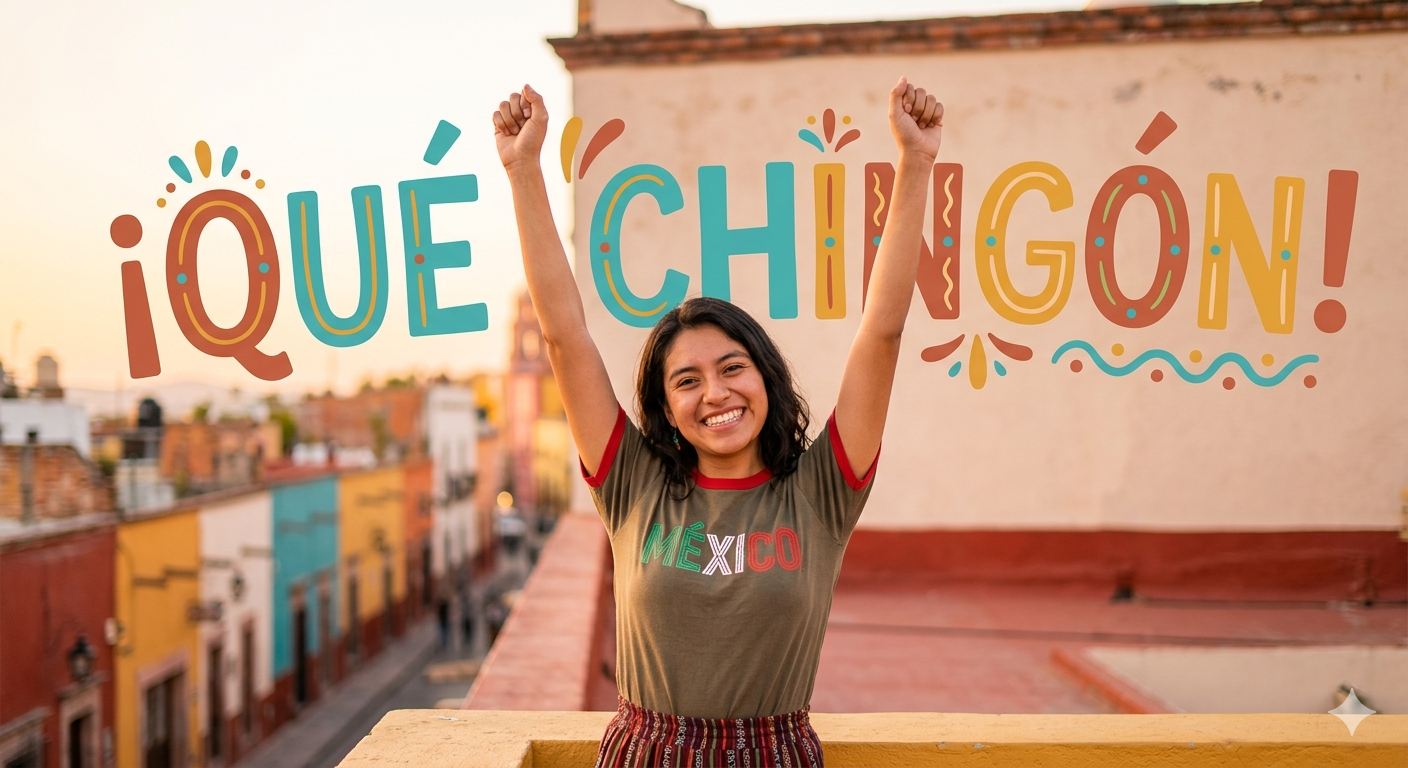
That feeling when you finally master Mexican Spanish: ¡Qué chingón!
🔥 Master the Slang, Master the Culture
Do you want to sound like a real Mexican instead of a foreigner reading from a textbook? 1-on-1 sessions with expert tutors like Ariadna, Paola, or Javier focus on real-life Spanish. No boring drills, just the language actually spoken on the streets.
What Does “Chingón” Really Mean?
At its most basic level, Chingón means “cool,” “awesome,” or “excellent.” But that’s just the surface. In Mexico, we use it to describe three main categories: people, objects, and situations.
1. Being a “Chingón” (The Person)
When you call someone a chingón, you are giving them the ultimate compliment. It means they are an expert, highly skilled, or simply “the best” at what they do.
Example: “Ese mecánico es un chingón.” (That mechanic is a genius/expert).
2. Something is “Chingón” (The Object)
Did you see an incredible mural in Coyoacán, for example. Then you can say “el mural está chingón.” Is that new taco spot spectacular? Then that taquería is chingona.
Other examples: “¡Qué chingón está tu carro!” (Your car is awesome!). Or “Mira qué clase de español tan chingona” (Look, what a great Spanish class).
3. “Está Chingón” (The Situation)
If you got a promotion or found out your favorite band is coming to Mexico City, the situation is chingona. It’s a way to express high-level satisfaction with life.
Master Table: Uses and Variations of the “Ching-” Family
To help you navigate the 100+ possible meanings, here is a table with the most common variations used in Mexican Spanish:
| Term | Main Meaning | Example Use |
|---|---|---|
| Chingón / a | Excellent, awesome, expert. | “Mi profe es bien chingón.” |
| Chingonería | Something of great quality. | “Ese mural es una chingonería.” |
| Chingonsísimo | Super excellent (extra emphasis). | “El viaje estuvo chingonsísimo.” |
| Chingonada | A magnificent action or thing. | “¡Qué chingonada de gol hizo!” |
| Se chingó | It broke / stopped working. | “Mi celular ya se chingó.” |
| Se lo chingaron | They beat him / He was robbed. | “A Juan se lo chingaron en el examen.” |
| Chingadera | Low-value item or bad action. | “¿Cuánto cuesta esta chingadera?” |
| No la chingues | Don’t mess with me! / No way! | “¿No vas a venir? ¡No la chingues!” |
| Chingaquedito | Subtly annoying person. | “Tu primo es un chingaquedito.” |
| Se lo llevó la chingada | He died or lost everything. | “A Pepe se lo llevó la chingada.” |
| Deja de estar chingando | Stop bothering me. | “Juan, ya deja de estar chingando.” |
| No estés chingando | Stop bothering me | “Juan, no estés chingando, porque te voy a partir tu madre” |
| Está hasta la chingada | It’s extremely far away / In the middle of nowhere.. | “When are we going to arrive? This place is hasta la chingada.” |
| Hijo de la chingada | A strong insult. | “¡Te voy a partir tu madre, hijo de la chingada!” |
| Chinga tu madre | Very very strong insult | “¡Chinga tu madre, Cabrón!” |
If someone tells you “No estés chingando”, they are basically saying a very aggressive “Stop fucking with me” or a direct “Stop bothering me”.
Grammar of Excellence: “Chingón” vs. “Chingonería”
As a grammar teacher, I can tell you that Spanish loves to transform words. Chingón is no exception. If you want to truly impress your Mexican friends, try using these variations:
- Chingonería: A noun used to describe a magnificent object or a feat of excellence. “Ese libro es una chingonería.”
- Chingonada: Similar to the above, but often used for a “cool thing” or a “master move.”
- Chingonamente: An adverb. Doing something “chingonamente” means doing it perfectly or with incredible style.
Is it a Bad Word? (The Million Dollar Question)
This is where many foreigners get nervous. Is Chingón considered a “curse word”?
The short answer: It’s informal, but generally not offensive. While its cousin, the verb chingar, can be very aggressive, the word Chingón has been “rehabilitated” by Mexican culture. You probably shouldn’t use it in a formal job interview with a 70-year-old CEO, but in a casual office where you use “tú” with your colleagues, at a party, or with friends, it is perfectly acceptable.
Pro-Tip: If you want to be slightly more polite while keeping the meaning, some people use “Chingonsísimo” to add even more emphasis without sounding as “rough.” Example: “El viaje a México estuvo chingonsísimo.”
Why “Chingón” is Central to the Mexican Identity
To truly understand this word, you have to understand the Mexican spirit of resilience. Being a chingón isn’t just about being lucky; it’s about “rifarse” (taking a risk, putting yourself on the line) and coming out on top. It’s about the street vendor who builds a successful business from nothing, or the student who masters a difficult subject. We celebrate the chingón because they represent the best of us: our ingenuity and our strength.
What is a “Chingadera”?
Chingadera has two main meanings in Mexico:
- An object that we give little value to (junk/thingamajig). Example: “¿Cuánto cuesta esta chingadera?”
- When someone does something bad or hurtful (a “dirty trick”). Example: “Juan hizo muchas chingaderas en la fiesta: he hit Beto and fell while dancing because he was drunk.”
No la chingues
Mexicans say this phrase to indicate disbelief or to tell someone to stop messing around: “No vas a venir a mi fiesta, no la chingues.” It’s equivalent to saying “Don’t mess with me” or “You’ve got to be kidding me.”
Se chingó vs. Se lo chingaron
When we use “se chingó,” we mean that an object broke or stopped working. For example, if your car broke down, I could say: “Tu carro ya se chingó.”
If we say to a person “te chingaste,” it means “you’re screwed” or “you lost.” In the third person (“él se chingó”), it refers to someone who has failed or lost a battle.
Common Mistakes to Avoid
Don’t fall into the tourist traps! Keep these two things in mind:
- Don’t confuse it with “Chingaquedito”: This refers to someone who annoys others in a subtle or passive-aggressive way. Very different!
- Watch your tone: As with everything in Mexican Spanish, intonation matters. A sarcastic “Uy sí, mira qué chingón” means the exact opposite of a compliment.
Conclusion: Start Using Your Secret Weapon
Now that you know the power of Chingón, it’s time to use it. Start small. The next time you see something you like, try a “¡Está chingón!” and watch the smiles you get. Just remember: keep it for informal situations among friends.
Ready to speak real Mexican Spanish?
This post is part of our Ultimate Guide to Mexican Slang. If you want to dive deeper and practice these words in a safe and fun environment, I’m here to help.